Most construction disputes in Lahore don’t start on site. They start with a weak contract. A one-page agreement, a verbal promise about “good material”, or a rate with no specification behind it can cost you lakhs later.
This construction contract checklist covers the 15 things to check before signing a contractor. Use it whether you are building a 5 Marla house in Johar Town, a 1 Kanal home in DHA, or managing a project from abroad. Each point explains what to look for, and what a red flag looks like.
Why a written construction contract matters
A written contract is your only real protection if work is delayed, material is changed, or costs suddenly rise. In Pakistan, contracts are governed by the Contract Act 1872, and a clear written agreement is much easier to enforce than a verbal one.
A good contract protects the contractor too. Both sides know exactly what is included, what it costs and when it is due. That clarity is what keeps a project calm.
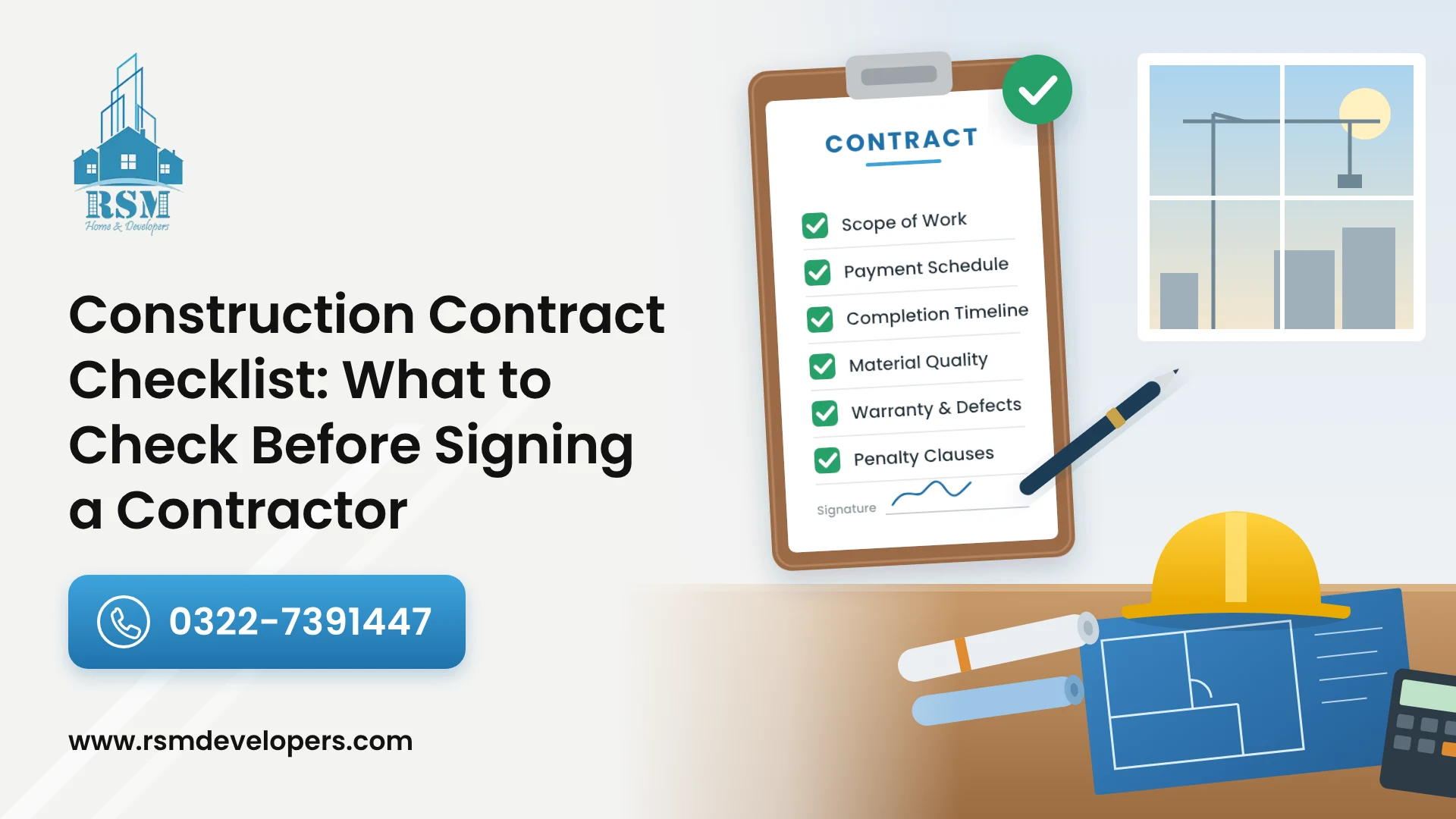
The 15-point construction contract checklist
1. Full details of both parties
The contract should name you and the contractor clearly: full names, CNIC numbers, addresses and contact numbers. If it is a company, check its registered name and office address. Avoid signing with someone who only gives a first name and a mobile number.
2. Exact project and plot details
Write the plot number, block, society and plot size (Marla or Kanal). Mention the covered area in square feet and the number of floors. This stops any later argument about what “the house” actually included.
3. Clear scope of work
This is the most important part of any construction agreement checklist. The contract must say exactly what is included:
- Grey structure only, or full turnkey (finishing included)
- Excavation, foundation, basement (if any), floors, roof and boundary wall
- Electrical, plumbing and sewerage work
- Who handles naqsha approval and submissions to LDA, DHA, Bahria Town or your society
Anything not written is usually treated as “extra”. If something matters to you, put it in writing. Also state who pays for the temporary electricity and water connection, curing water and debris removal, and who keeps leftover material.
4. Approved drawings attached
The approved naqsha, structural drawings, and electrical and plumbing drawings should be attached to the contract. The contractor must build according to these drawings. Any change should need your written approval.
5. Material specifications and brands
Vague words like “A-class material” or “best quality” mean nothing in a dispute. The contract should list:
- Brick type and class
- Cement brand
- Steel grade and brand (for example, Grade 60)
- Concrete mix ratio, damp-proof course (DPC) and anti-termite treatment
- Sand and crush source (for example, Chenab sand and Sargodha crush)
- Pipe, wire and fitting brands for plumbing and electrical work
For turnkey contracts, add tile, sanitary, paint and wood specifications, or a per-item allowance in PKR. Also attach a BOQ (bill of quantities), so quantities are fixed and not just brands.
6. Rate and total cost
Check whether the rate is per square foot or a lump sum. Confirm the covered area it is calculated on, and the total contract value in PKR. Ask whether the rate includes labour only, or labour plus material.
7. Price escalation clause
Steel and cement prices in Pakistan can change quickly. The contract should say what happens if material rates rise during construction. Is the price fixed, or can it be revised? If it can, by how much, and with what proof? Without this clause, you have no control over sudden increases.
8. Payment schedule linked to milestones
Never pay a large amount upfront. A safe contract links each payment to completed work, for example:
- Advance on signing (a small share, ideally no more than 10-15% of the contract value)
- Foundation and plinth complete
- Ground floor slab complete
- First floor slab complete
- Brickwork and plaster complete
- Final payment after handover, snag list clearance, and receipt of as-built drawings and the completion certificate
Many owners also hold back a retention of around 5% of each bill, released after the defect liability period ends. Ask for receipts for every payment, and pay through bank transfer where possible.
9. Project timeline and penalty for delay
The contract should give a start date, a completion date and key milestone dates. Add a penalty clause for delays caused by the contractor, such as a fixed amount per week of delay with an overall cap. To keep it fair, the contract should also say what happens if you pay late or delay approvals. Also list fair exceptions, such as smog restrictions, extreme weather, or delays in society approvals.
10. Change order process
You will probably change something during construction. The contract should say that every change is agreed in writing, with its cost and time impact, before work starts. This prevents surprise bills at the end. It should also say the contractor cannot hand work to subcontractors without your written consent.
11. Quality checks and site supervision
Who supervises the site, and how often? Check whether the contractor provides a site engineer, and whether you or your architect can inspect work at each stage. The contractor should also be responsible for worker safety and any damage to neighbouring property. For overseas clients, ask for regular photo and video updates.
12. Testing and inspections
A good contract mentions basic quality tests, such as concrete cube tests, steel checks and water-tightness tests for roofs and bathrooms. It should also allow inspections by the relevant authority (LDA, DHA, Bahria Town or your society’s building control) without extra charges.
13. Warranty and defect liability
Ask what is covered after handover, and for how long. Seepage, cracks, leaks and structural defects should be listed clearly, with a defined period for each (for example, at least one year for finishing work and longer for structural defects). The contract should say how quickly the contractor will respond to a complaint, and that repairs are free during the warranty period.
14. Termination and dispute resolution
What happens if either side wants to end the contract? The agreement should explain notice periods, how completed work will be valued, and how disputes are settled. Many contracts name arbitration first, before going to court. If yours does, name the arbitrator or how one will be appointed. Arbitration in Pakistan falls under the Arbitration Act 1940.
15. Signatures, witnesses and stamp paper
Both parties should sign every page. Add two witnesses with their CNIC numbers. In Punjab, contracts are now executed on e-stamp paper; ask a lawyer which stamp duty value applies to your contract. Keep the original and a scanned copy.
Quick construction contract checklist table
| # | What to check | Red flag |
|---|---|---|
| 1 | Full details of both parties | ⚠No CNIC or office address |
| 2 | Plot number, size and covered area | ⚠“House in DHA” with no plot details |
| 3 | Scope of work (grey or turnkey) | ⚠“Complete house” with no list |
| 4 | Approved drawings attached | ⚠Work starts without drawings |
| 5 | Material brands and grades | ⚠“A-class material” only |
| 6 | Rate and total cost in PKR | ⚠Rate with no covered area |
| 7 | Price escalation clause | ⚠No mention of rate changes |
| 8 | Milestone-based payments | ⚠Large advance before any work |
| 9 | Timeline and delay penalty | ⚠No completion date |
| 10 | Change order process | ⚠Verbal changes only |
| 11 | Site supervision | ⚠No engineer on site |
| 12 | Quality tests | ⚠No testing mentioned |
| 13 | Warranty and defect liability | ⚠No warranty in writing |
| 14 | Termination and disputes | ⚠No exit terms |
| 15 | Signatures, witnesses, stamp paper | ⚠Unsigned pages or no witnesses |
Things to check before hiring a contractor (before the contract stage)
The contract is only as good as the company behind it. Before you even reach the agreement, check:
- Past projects: visit at least one completed house and one site under construction
- Client references: speak to two or three past clients directly
- Registration: check the contractor’s PEC (Pakistan Engineering Council) licence and category, and its NTN/FBR registration
- Written estimate: compare detailed BOQs, not just per-square-foot rates
- Communication: a contractor who is slow to reply before signing rarely improves after
For more detail, read our guide on how to choose the best construction company in Lahore.
Extra checks for overseas Pakistanis
If you are building from the UK, USA or the Gulf, add these points to your contractor agreement checklist:
- A trusted family member or architect named as your site representative
- A clear power of attorney, attested by the Pakistani embassy or consulate, if someone signs on your behalf
- Weekly or monthly progress reports with photos and videos
- Payments only by bank transfer, against completed milestones
- Video calls at major stages, such as slab casting
How RSM Developers handles construction contracts
At RSM Developers, every project starts with a detailed written agreement. It includes the scope, attached drawings, material brands, and a milestone-based payment plan with no hidden costs.
We share monthly progress updates with photos and audit reports, which helps a lot for our overseas clients. Our team handles grey structure and turnkey construction across DHA, Bahria Town, Lake City, Johar Town and other Lahore societies. We are ISO 9001 and ISO 14001 certified.
Conclusion
A strong construction contract in Pakistan is not about mistrust. It is about clarity. Go through this construction contract checklist line by line before you sign, and don’t accept vague words where numbers and brands should be.
Want a second opinion on your contract?
Get a clear quote for your plot, a free consultation with RSM Developers, or a free 3D design preview of your home. Call or WhatsApp our team today.
Frequently asked questions
What should a construction contract include?
A construction contract should include both parties’ details, plot details, a clear scope of work, attached drawings, material brands and grades, the total cost, a milestone-based payment schedule with retention, a timeline with delay penalties, a change order process, warranty terms, and termination and dispute clauses.
What should I check before signing a contractor in Lahore?
Check the contractor’s past projects, client references, and PEC licence and registration. Then read the contract for scope, material specifications, payment milestones, completion date and warranty. Never sign a contract that uses vague terms like “A-class material” without listing brands, grades and quantities.
Is a construction contract on stamp paper legally valid in Pakistan?
Yes. A written contract is valid under the Contract Act 1872 even without stamp paper. However, paying the correct stamp duty matters, because an under-stamped agreement cannot be used as evidence in court until the duty and a penalty are paid. In Punjab this is done through e-stamp paper, so confirm the correct value with a lawyer before signing.
How much advance should I pay a contractor?
Keep the advance small, ideally no more than 10-15% of the contract value, and link every other payment to completed work, such as the foundation, each slab and finishing. Avoid paying large sums before work starts. Ask for a receipt for each payment and use bank transfers so you have a clear record.
What is a price escalation clause in a construction contract?
A price escalation clause explains what happens if material prices, such as steel or cement, rise during construction. It states whether the rate is fixed or can be revised, by how much, and what proof the contractor must show. It protects you from sudden, unexplained cost increases.
Can overseas Pakistanis sign a construction contract remotely?
Yes. Overseas clients can sign the contract abroad and courier it back, or sign through a trusted representative holding a power of attorney attested by the Pakistani embassy or consulate. Add clauses for regular photo and video updates, milestone payments by bank transfer, and video calls at key stages, so you stay in control from abroad.